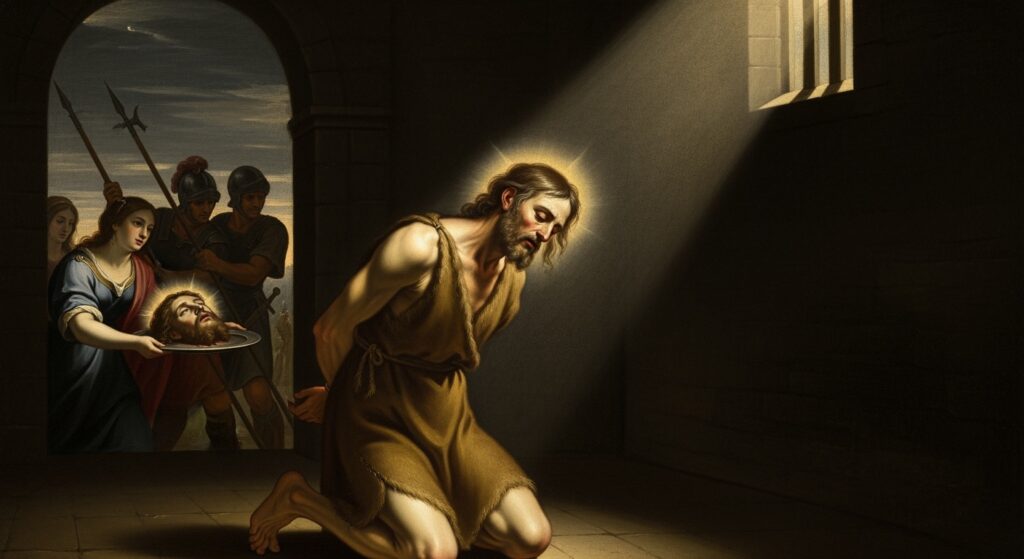
On August 29, the Church solemnly commemorates the Passion of St. John the Baptist, the Forerunner of Christ, who sealed his witness to the truth with his blood. Known as the last of the prophets and the greatest among those born of women (cf. Matthew 11:11), John the Baptist stands as a fearless herald of conversion, repentance, and fidelity to God.
John’s Mission
From his miraculous birth, foretold by the angel Gabriel, John’s vocation was to prepare the way of the Lord (cf. Luke 1:17). Living in the desert in radical poverty and prayer, he called Israel to repentance and baptized them in the Jordan. His voice was that of the prophet Isaiah: “Prepare the way of the Lord, make straight his paths” (Mark 1:3).
But John’s mission was not to draw disciples to himself. When Christ appeared, John pointed beyond himself: “Behold, the Lamb of God, who takes away the sin of the world” (John 1:29). He decreased so that Christ might increase.
The Prophet’s Martyrdom
John’s fidelity to truth eventually led to his death. He rebuked Herod Antipas for his unlawful union with Herodias, his brother’s wife (cf. Mark 6:18). Herodias, nursing a grudge, sought John’s destruction. The occasion came at Herod’s birthday banquet, when Herodias’s daughter danced before the guests. Pleased, Herod promised her anything she desired. Prompted by her mother, she demanded the head of John the Baptist on a platter. Though distressed, Herod gave the order, and John was beheaded in prison.
Thus John, who had baptized Christ and proclaimed Him to the world, bore final witness by shedding his blood in defense of God’s law.
The Meaning of His Passion
The Passion of St. John the Baptist is unique among the saints’ feasts. For most saints we celebrate their “dies natalis,” the day of their birth into eternal life. For John, the Church honors both his birth (June 24) and his martyrdom (August 29), recognizing the special role he played in salvation history.
John died a martyr for marriage and truth. In a world where the sanctity of marriage is again contested, his witness is strikingly relevant. He shows that fidelity to God’s law is worth more than life itself.
A Eucharistic Connection
St. Bede the Venerable saw in John’s death a parallel with the Eucharistic sacrifice. John’s disciples buried his body, while Christians receive the Body of Christ. Just as John prepared the way for Christ’s ministry, his martyrdom foreshadows Christ’s own Passion.
The Catechism of the Catholic Church recalls that John is the “immediate precursor” of Christ, sent to prepare for His coming (CCC 523). He is also the model of courage: his whole life was ordered toward pointing souls to Jesus.
Living the Feast
This feast invites us to:
-
Stand for truth even when it is costly, remembering John’s courage.
-
Revere marriage as God designed it, a covenant between man and woman.
-
Embrace humility, decreasing so that Christ may increase in us.
-
Prepare for Christ’s coming in our own lives through repentance and prayer.
Conclusion
The Passion of St. John the Baptist is not a tragedy but a triumph of truth. The Forerunner, who once pointed to the Lamb of God at the Jordan, now points to Him from eternity as the one who conquers sin and death.
On this feast, let us pray:
St. John the Baptist, fearless prophet and martyr for truth, pray for us, that we may be faithful witnesses to Christ in our time.