
On the 30th of November, the Christian churches celebrate the feast of St. Andrew.
It is a beautiful custom that, every year on this occasion, a delegation from the Catholic Church in the Vatican visits the Ecumenical Patriarch in Istanbul and participates in the celebrations. Sometimes, as in this year, the Pope himself takes part. Let us look back to understand the story behind this beautiful and fraternal celebration.
The Great Schism—a very sad moment in the history of the Christian churches—occurred in 1054, when the Eastern and Western Churches mutually excommunicated each other. Things remained that way until the 7th of December, 1965.
The lifting of the excommunications took place under Pope Paul VI, just before the close of the Second Vatican Council, through a joint declaration signed by the Pope and Patriarch Athenagoras. This declaration, presented first in Rome and later in Istanbul, was preceded by the “handing over of the head of St. Andrew.” This gesture—the transfer of the relics of St. Andrew—is less known to the public, and it occurred in September 1964.
Few people are aware of the “handing over of the head.” There are four shrines surrounding the high altar in St. Peter’s Basilica in the Vatican, corresponding to the four columns. Beneath the high altar rest the bones of St. Peter. The four surrounding shrines house Christendom’s most precious relics and are adorned with statues of the corresponding saints:
The largest portion of the True Cross (St. Helena)
The miraculous veil of St. Veronica (St. Veronica)
The lance that pierced the side of Christ (St. Longinus)
The skull of St. Andrew (St. Andrew)
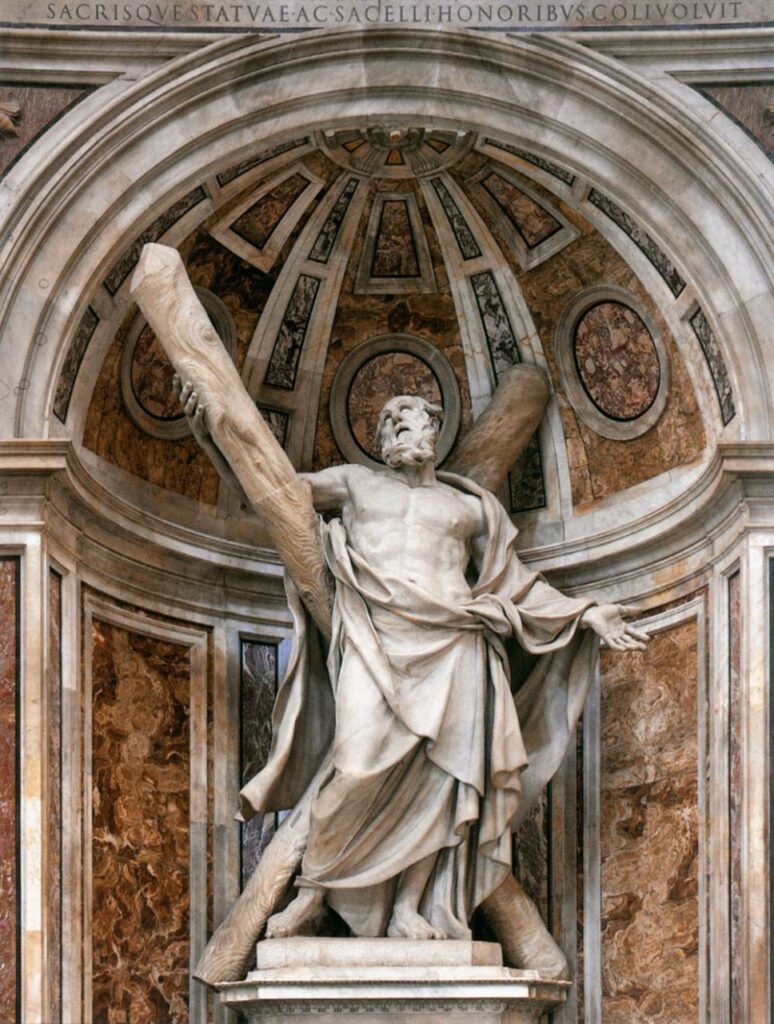
The statue of St. Andrew’s shrine remains in the Vatican Basilica. As you can see in the picture above.
However, the skull of St. Andrew is no longer kept in this shrine.
The skull originally came to Rome when it was given to Pope Pius II in 1461 by Thomas Paleologos, brother of the last Byzantine emperor. It was placed in the shrine depicted above when the new Basilica of St. Peter’s was constructed.
As an ecumenical gesture of goodwill, Pope Paul VI, in 1964, had the skull removed from its place in St. Peter’s and returned to the Greek Orthodox Church in Patras, where it remains to this day. Thus, one of the four column shrines surrounding the high altar of St. Peter’s Basilica is now without its relic—because the head has been handed over to the Orthodox Church.
Since 1964, the celebrations of the feast of St. Andrew in Istanbul have been a wonderful occasion of fraternal unity. The Eastern Orthodox Church regards St. Andrew as the “founder” of the See of Byzantium, that is, Constantinople—today the Ecumenical Patriarchate in Istanbul. There is therefore a beautiful traditional relationship between St. Peter (Rome) and his brother St. Andrew (Constantinople), who are united in faith.
But who is St. Andrew, “the First-Called”?
According to the New Testament, Andrew was born in the village of Bethsaida on the Sea of Galilee during the early first century. Like his younger brother, Simon Peter, Andrew was a fisherman. His very name means “strong,” and he was known for his good social skills.
In the Gospel of Matthew, it is said that Jesus was walking along the shore of the Sea of Galilee when He saw Andrew and Simon Peter fishing. He then called them to become His disciples and “fishers of men” (Matthew 4:18–19). Along with Peter, James, and John, Andrew later asked Jesus to explain the signs of His return and the end times (Mark 13:3–4).
In the Gospel of Luke, Andrew is not initially mentioned by name. It describes Jesus using a boat—believed to belong to Simon alone—to preach to the multitudes and to perform the miraculous catch of fish after a night of failure. Later, in Luke 5:7, it is mentioned that Simon was not the only fisherman on the boat, and in Luke 6:14 Andrew is finally identified as Simon Peter’s brother.
However, the Gospel of John tells a different story. Andrew was originally a follower of John the Baptist (John 1:35–40). After John referred to Jesus as the “Lamb of God” (John 1:35), Andrew left John to follow Jesus (John 1:37) and soon told his younger brother Simon Peter about Him (John 1:40).
Little else is said about Andrew in the Gospels, but it is believed that he was one of Jesus’ closer disciples. It was Andrew who told Jesus about the boy with the loaves and fishes (John 6:8). When Philip wanted to speak to Jesus about Greeks who sought Him, he spoke to Andrew first. Andrew was also present at the Last Supper.
According to Christian tradition, Andrew went on to preach the Good News around the shores of the Black Sea and throughout what is now Greece and Turkey. He was martyred by crucifixion in Patras. He was bound, rather than nailed, to the cross—as described in the Acts of Andrew. He was crucified on a cross of the form known as crux decussata, an X-shaped cross or “saltire,” now commonly referred to as “St. Andrew’s Cross.” It is believed Andrew requested to be crucified in this way because he considered himself unworthy to die on the same kind of cross as Jesus.
Andrew’s remains were originally preserved in Patras. However, it is said that St. Regulus, a monk at Patras, received a vision instructing him to hide some of Andrew’s bones. Shortly afterward, many of Andrew’s relics were transferred to Constantinople by order of Emperor Constantius II around 357. Regulus later received a second vision commanding him to take the bones “to the ends of the earth” and to build a shrine wherever he shipwrecked. He landed on the coast of Fife, Scotland.
The Founder of the Church in Byzantium
The Greek Orthodox tradition holds that Andrew was the first of the original apostles and that he founded their Church in Constantinople. The Orthodox Church of Constantinople teaches that after Andrew founded it, his successor was Stachys, who served from 38 to 64 A.D. Tradition maintains that Stachys was one of the Seventy Apostles of the Lord. A Christian named Stachys is mentioned in Romans 16:9. In 38 A.D., the Apostle Andrew appointed him as the first bishop of the city of Byzantium, which three centuries later would be renamed Constantinople.
The Bible does not record the names of the seventy disciples sent out by Jesus, nor does it ever refer to them collectively as apostles (see Luke 10:1–17). The information about Stachys comes from The Synaxarion, which appears to have drawn from a third-century writing by Hippolytus: Stachys, Bishop of Byzantium (Hippolytus, On the Seventy Apostles, excerpted from Ante-Nicene Fathers, Vol. 5, edited by Alexander Roberts and James Donaldson, American Edition, 1886. Online Edition Copyright © 2005 by K. Knight).
