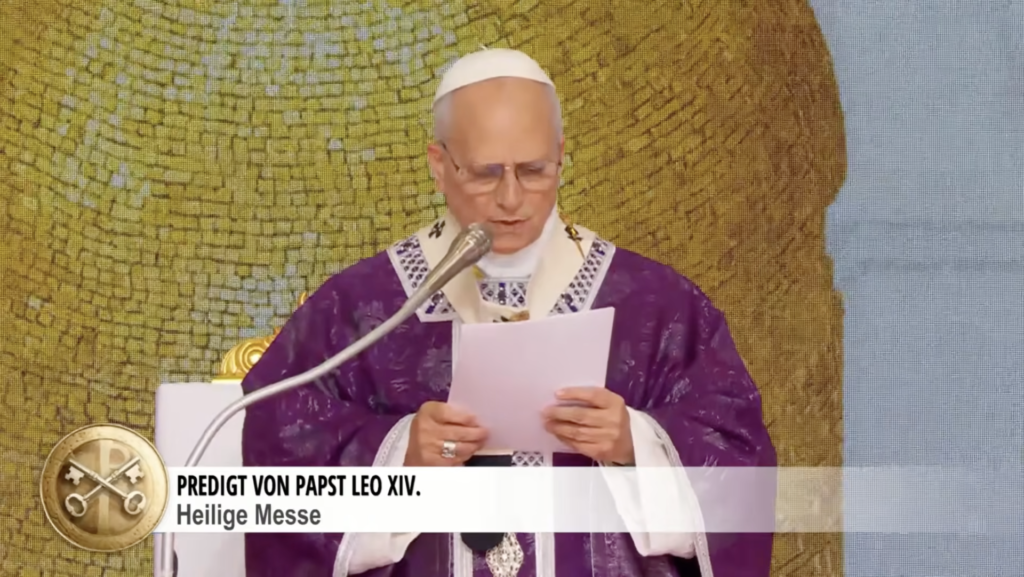
On Saturday, March 28, Pope Leo XIV brought his one-day apostolic visit to the Principality of Monaco to its climax with the celebration of Holy Mass at Louis II Stadium, where he delivered a forceful appeal for peace on the eve of Holy Week. Preaching on John 11:45–57, the Holy Father said that the wars staining the present age are “the result of the idolatry of power and money,” and urged the faithful not to grow accustomed to violence.
The Pope’s homily took as its starting point the Sanhedrin’s decision to put Jesus to death after the raising of Lazarus. In that Gospel scene, Pope Leo said, one sees how fear, calculation, and attachment to power can harden the heart against innocence. “Even today,” he asked, “how many calculations are made in the world to kill innocent people; how many false reasons are used to get them out of the way!” In those words, the Holy Father drew a direct line from the Passion of Christ to the political and military logic that still destroys human life today.
At the heart of the Pope’s message was a moral and spiritual diagnosis of war. He did not treat conflict merely as a failure of diplomacy or an unfortunate fact of history. Rather, he located its roots in idolatry: the worship of power, domination, and material interest in place of the living God. God’s grace, he said, “illuminates our present,” precisely because it exposes the false gods that lead men to enslave and destroy one another.
From there, Pope Leo XIV issued one of the most arresting lines of the homily: “Every truncated life is a wound to the body of Christ. Let’s not get used to the rumble of weapons or the images of war!” The phrase is unmistakably pastoral. It is also profoundly Eucharistic and ecclesial. Human life is not disposable, and violence against the innocent is not merely a political crime; it is a wound inflicted upon Christ’s Mystical Body.
The Pope also rejected any notion of peace built merely on strategy or equilibrium. Peace, he said, “is not a mere balance of forces, but the work of purified hearts, of those who see in the other a brother to take care of, not an enemy to bring down.” In this, Pope Leo’s language placed Christian peace far above geopolitics. Peace is not simply the absence of open combat, nor the temporary restraint of competing powers. It is the fruit of conversion.
Yet the Holy Father’s homily was not limited to denunciation. He turned repeatedly to mercy as God’s answer to evil. “The true name of his omnipotence,” the Pope said of God, is “mercy.” That mercy, he continued, is what “saves the world,” because it bends down to the whole of human existence, from life in the womb to old age, from strength to frailty, from health to sickness. In that passage, Pope Leo joined his anti-war appeal to a broader defense of the human person in every stage and condition of life.
The setting itself underscored the significance of the day. The papal Mass was held in Monaco’s Louis II Stadium, which can hold more than 18,000 people, and formed the culminating public event of the Pope’s roughly eight-hour visit to the principality, made at the invitation of Prince Albert II. Before Mass, the Holy Father toured the stadium in a golf cart, greeting and blessing the faithful as they waved Vatican and Monégasque flags.
At the end of the liturgy, Archbishop Dominique-Marie David of Monaco thanked the Pope for strengthening the local Church in faith and hope. The Holy Father, for his part, left the archdiocese a contemporary sculpture of St. Francis of Assisi, the saint of peace, fraternity, and reconciliation. It was a fitting final gesture after a homily that called Catholics, on the threshold of Holy Week, to reject the idols of this world and to follow Christ, whose victory comes not through domination but through the Cross.