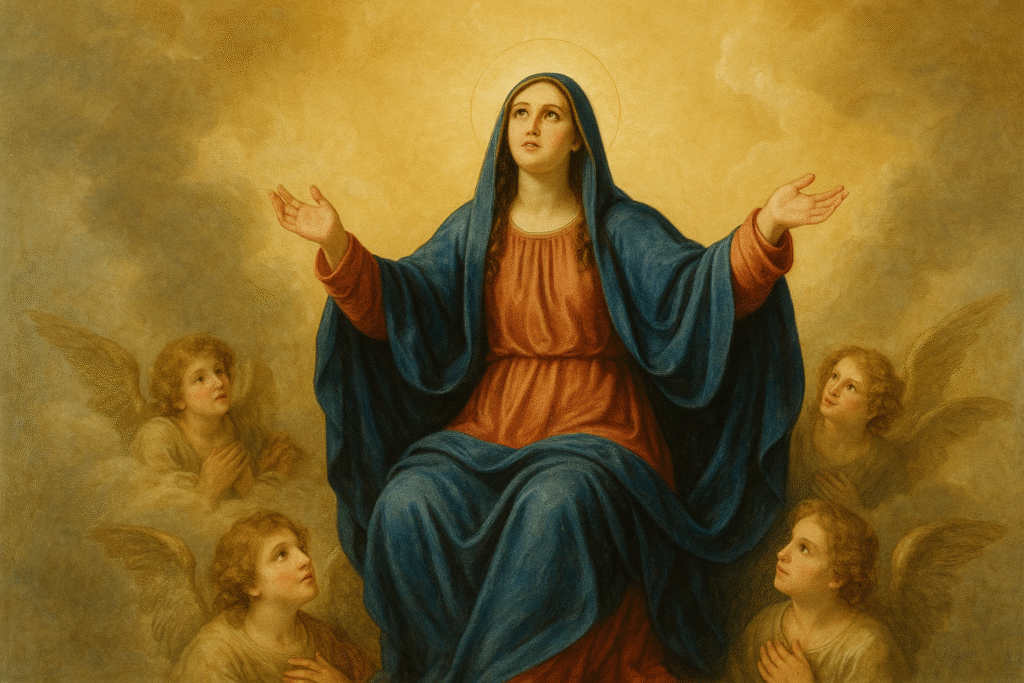
On August 15 the entire Catholic world celebrates one of the greatest feasts of the liturgical year: the Solemnity of the Assumption of the Blessed Virgin Mary. This day reminds us that Mary, the Mother of God, at the end of her earthly life was taken up body and soul into heavenly glory. For Catholics worldwide it is a day of deep gratitude, joy, and catechetical significance.
A Church Dogma, Grounded in Tradition
The dogma of the Assumption was solemnly defined on 1 November 1950 by Pope Pius XII in the apostolic constitution Munificentissimus Deus. Yet the belief itself is much older—rooted in the Church’s living Tradition and borne by the sensus fidelium, the faith-sense of the People of God. Already in the early Church it was proclaimed that “the tomb of Mary is empty.”
As the Catechism states:
“The Assumption of the Blessed Virgin is a singular participation in her Son’s Resurrection and an anticipation of the resurrection of other Christians” (CCC 966).
Why This Feast Is Timely Today
In an age of relativism, materialism, and superficiality, this solemnity reminds us that the human person is destined for heaven—not only with the soul, but also with the body. Mary’s Assumption is a promise to all who live in grace: we too will one day be united in body and soul with Christ, if we remain faithful to Him. She is, as Dr. Scott Hahn often emphasizes, “the first redeemed member of the Body of Christ—and thus our hopeful forerunner.”
Who Is This Feast For?
For every Catholic engaged in life’s battle: fathers striving to protect their families, mothers praying for their children, young people trying to remain faithful to their baptism, priests serving souls day in and day out.
Mary is their mother—not symbolically, but truly. And on August 15 we are reminded that she already is where we hope to arrive. She prays for us, she guides us, she is our Queen.
A Call to Fidelity
The Assumption is not a sweet “Mary tale,” but a powerful call to conversion. As Pope Leo XIII emphasized in Octobri Mense (1891), true Marian devotion always leads to imitation: “Whoever honors Mary must follow her example.”
Today’s liturgy has us sing with the words of Psalm 45:
“At your right hand stands the queen, arrayed in gold of Ophir.”
This is a royal vision, but also an eschatological reality: Mary is the crown of God’s work of creation.
In Conclusion
On this day, when heaven and earth touch in the person of Mary, we may echo Elizabeth’s wonder:
“And why is this granted to me, that the mother of my Lord should come to me?” (Lk 1:43)
And we should also answer with Mary herself:
“My soul magnifies the Lord.” (Lk 1:46)
Amid the political and cultural confusion of our time, let us fix our gaze on Mary anew—not as an escape, but in faith. She is the sign of hope, a beacon of purity, the guarantee that the last word belongs not to the grave but to heaven.
Holy Mary, Mother of God, pray for us sinners, now and at the hour of our death. Amen.
O Immaculata, I am all yours.
Totus Tuus.