
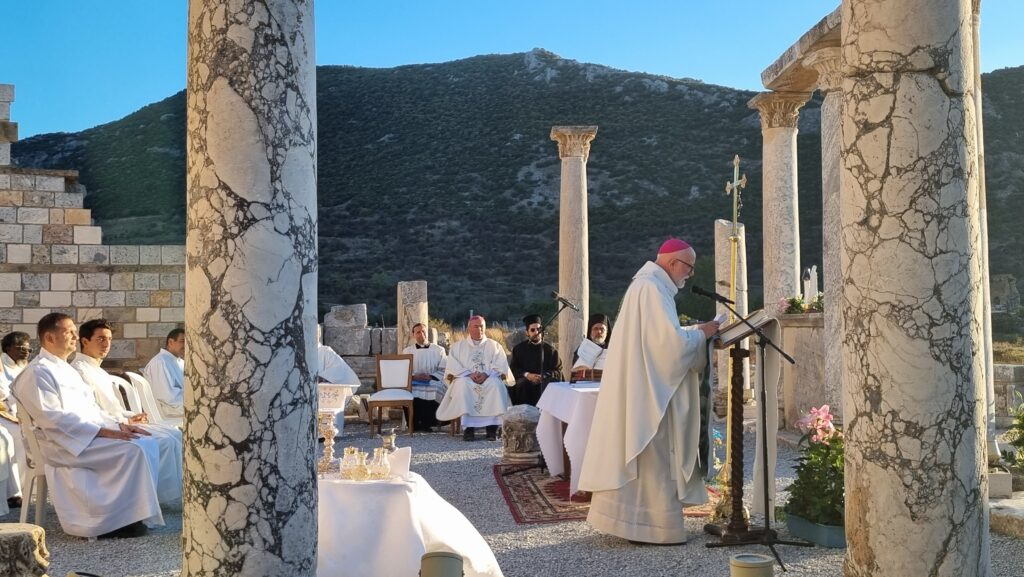
Near the main entrance of the famous ancient city of Ephesus, on the road connecting Selçuk and Kuşadası, lie the ruins of the Church of Mary. Also known as the Council Basilica, this church hosted the 3rd Ecumenical Council in June and July of 431, during which some of the fundamental principles of Christianity were defined.
That year, more than 200 bishops gathered in the East’s first church dedicated to the Virgin Mary and decided to bestow upon Mary the title “Mother of God,” in Greek Theotokos. This was one of the most significant decisions made at the Council and marked a truly historic turning point for the Church.
An excerpt from the diary kept by Dominican priests in İzmir on October 29, 1951, helps us understand this more deeply:
“… In the year 431, the Council convened, and because of its extraordinary importance, it left an indelible mark on Church history. Right beneath the majestic vaults of this basilica, the fathers gathered here proclaimed, against the blasphemies of Nestorius, the dogma of ‘Theotokos,’ that is, the divine motherhood of Mary.
From early morning, people gathered around the Church of Mary to await the decisions of the Council, which lasted all day. When the doors opened in the evening, Cyril, Bishop of Alexandria, read the Council’s decision before a large crowd. The decree declared that Mary was truly the Mother of God, that Nestorius had committed blasphemy by claiming otherwise, and that he was deposed from his episcopal see in Constantinople.
… The enthusiasm of the people of Ephesus upon hearing the news was indescribable. It was an extraordinary outpouring of joy, and the entire city resounded with jubilant hymns. When the bishops left the basilica, night had already fallen; the people accompanied them home, lighting the streets with thousands of torches and perfuming the air with incense. The city was illuminated everywhere, as on great feast days.
… Through the kind and generous permission of the government, after almost eleven centuries, the echoes of Ephesus once again resounded with the most beautiful hymns and songs of our faith. Indeed, on October 29, the anniversary of the proclamation of the young and courageous Republic of Turkey, a Mass was celebrated by the Archbishop of Izmir upon the ruins of the Council Basilica; the altar used the nearly intact apse as its backdrop.”
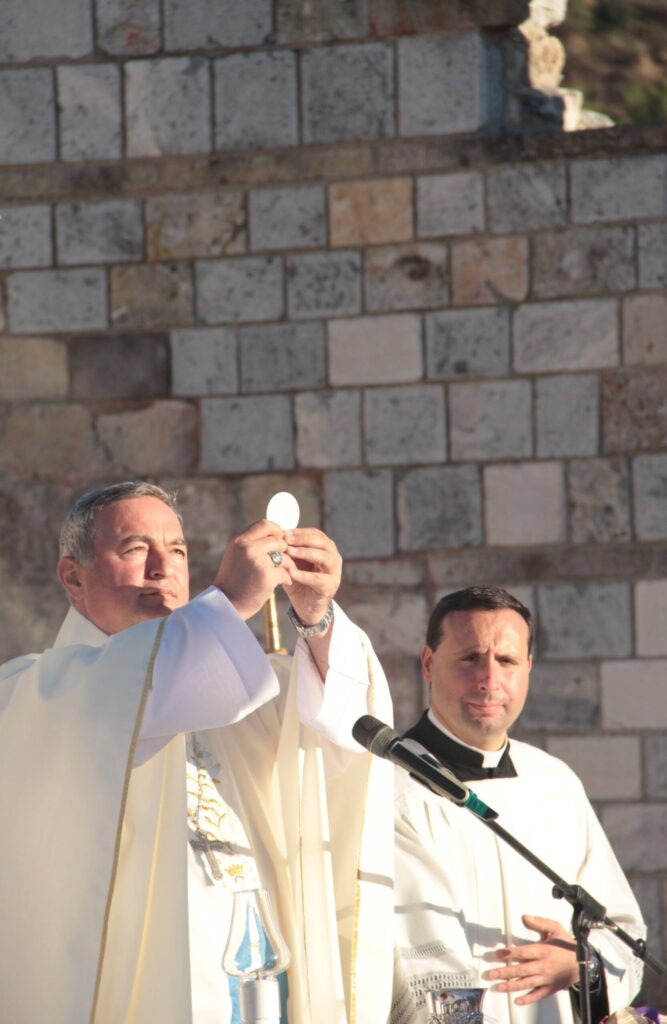
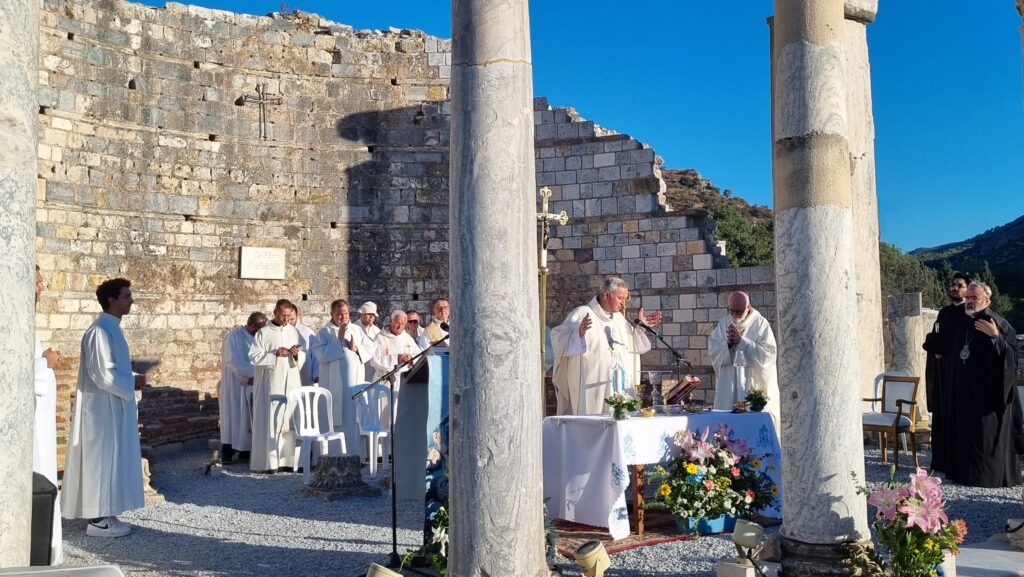
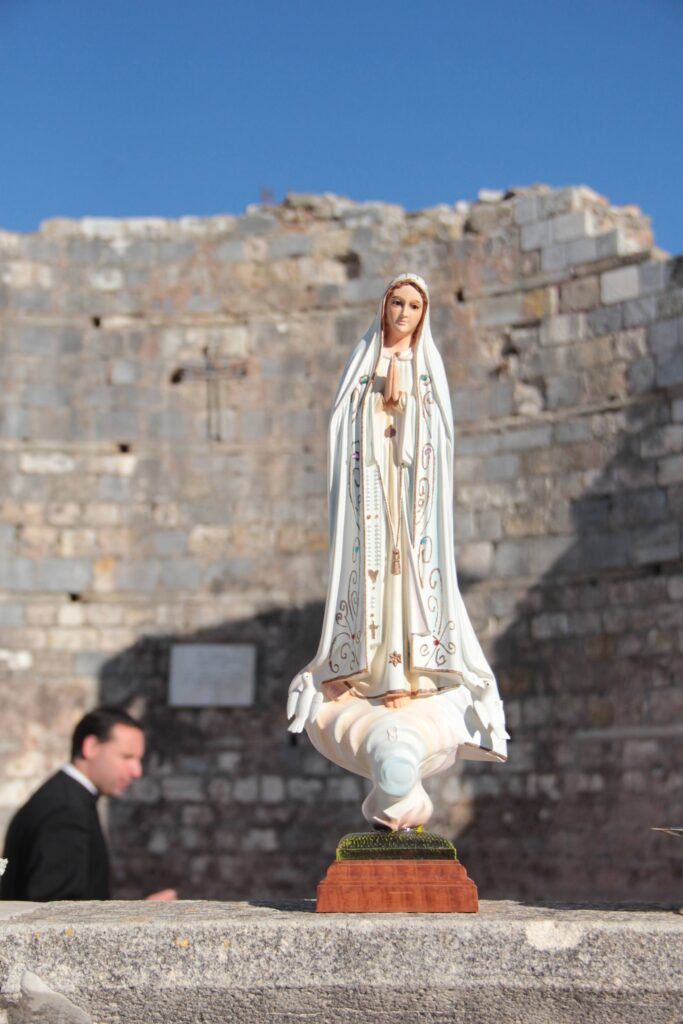
Pilgrimages and celebrations were held at this historic site in 1951 and 1968, and they continue to this day — for instance, as on Sunday, October 5, 2025, to honor the Theotokos. It is worth recalling that in 1931, on the fifteenth centenary of the Council of Ephesus, Pope Pius XI instituted the Feast of the Divine Maternity of Mary, celebrated on October 11.
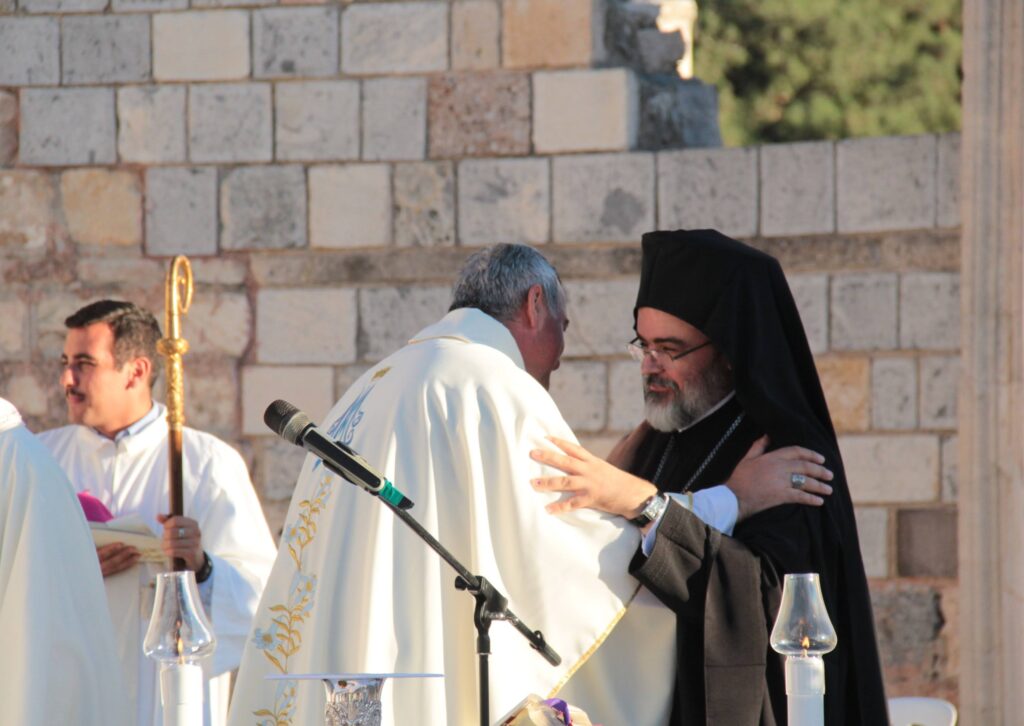
The solemn Mass was presided over by Archbishop Monsignor Arjan Dodaj of Tirana-Durrës (Albania) and concelebrated with Metropolitan of Izmir and President of the Catholic Bishops’ Conference of Turkey, Martin Kmetec, and Izmir’s new Vicar General, Father Pascal Robert. The celebration was also attended by Bartholomeos Samaras, Greek Orthodox Metropolitan of Izmir.
After the day’s Gospel reading — Luke 17:5–10 — proclaimed by Father Marius Dunaj from the Capuchin community living at the nearby and equally renowned House of the Virgin Mary, Archbishop Arjan, who had been invited to the symposium organized two days earlier by the Diocese of Izmir for the 1700th anniversary of the Council of Nicaea, began his homily saying:
“I wish to reflect and listen to what the Lord is pointing out to us through the voice of Mary, ‘the most excellent and unique member of the Church’ (Lumen Gentium, no. 53).”
He then reflected on three Gospel scenes.
The first scene: “Let us contemplate the moment when the Archangel Gabriel appears to a young girl of Nazareth to announce what humanity had long awaited — a mystery both wondrous and difficult to accept. In that moment, Mary found herself, on behalf of all humankind, before the greatest of all calls: to become the Mother of God, and, in that very mystery, to participate freely and consciously in God’s plan of salvation. Thus, the yes of the ‘handmaid of the Lord’ (Luke 1:38) was a full, free, and unconditional consent to the divine plan. Mary accepted to become the Mother of the Messiah, ‘who came to save his people from their sins’ (Matt 1:21; Luke 1:31).”
The second scene, recalled by the Archbishop of Tirana, was the wedding feast at Cana: “Mary immediately perceived the needs of those in distress and interceded with her Son on their behalf: ‘They have no wine.’ In her, everything becomes closeness — to her Son in every act and word, and to every human need that springs from fragility and limitation. Mary’s unshakable faith becomes an unshakable hope, firm in the certainty that the Lord will act, fulfill his promise, and make his presence known. Mary is the Mother of Hope, and in her total surrender to the Father’s hands, she prepares the way for her Son’s saving work: ‘Do whatever he tells you.’ Through her divine motherhood, the Virgin not only brought the Son to humanity during his hidden life at Nazareth, but continues, with the same openness and compassion, to bring humanity to the Son.”
In the third scene: “In the Gospel, we find the Virgin Mother standing at the foot of the Cross, having followed her Son along the entire Way of the Cross and sharing in his suffering. Here, she no longer speaks, but her total openness to God reaches its peak as she accepts the loving request of the crucified Jesus: ‘Woman, behold your son… behold your mother’ (addressing John — and us). The motherhood of Mary, who had gradually opened her heart to Christ’s new family, now reaches its universal fullness in time: she becomes the Mother of the Church, the Mother of Mercy and of Love.
Therefore, Mary stands before every person as the purest, most beautiful, and holiest example — she alone, here on earth, possesses the deepest capacity to ‘be Church.’ … ‘Let us look to her as our model in learning how to build up the Church’ (St. John Paul II, 1979). Even now, in this dark period of human history, we turn to the Mother who is our source of faith, hope, and goodness.”

Archbishop Arjan concluded his homily with the 24th stanza of the Akathist Hymn:
“O merciful Mother,
you brought into the world for us
God’s eternally holy Word,
the most exalted of the saints;
accept our hymn with kindness!
Deliver us from every evil and harm;
save us from the punishment we deserve,
for we cry to you as your children:
Alleluia! Praise be to God!”
This magnificent celebration of the Theotokos was enriched by the hymns sung by the choirs of the Verbo Incarnato Sisters of Buca and of Notre-Dame de Lourdes Church in Göztepe, İzmir, conducted by Father Iosif Robu from St. Helen’s Church in Karşıyaka.
At the end of the ceremony, Monsignor Martin expressed heartfelt thanks to local authorities and the gendarmerie for their cooperation and support.
Text and photos: Nathalie Ritzmann
