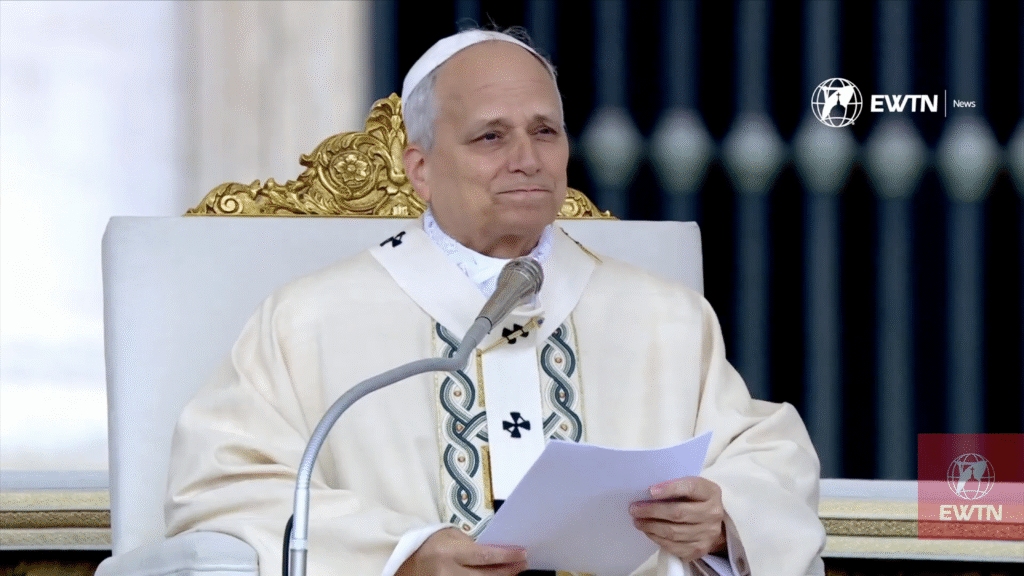
With ancient ceremony and renewed hope, the universal Church gathered yesterday in Saint Peter’s Square for the inaugural Mass of Pope Leo XIV. Taking place on the 5th Sunday of Easter, this solemn liturgy marked the official beginning of his Petrine ministry — a moment steeped in tradition, liturgical beauty, and spiritual clarity.
As the successor of Saint Peter, Pope Leo XIV began the day in prayer before the Apostle’s tomb. In a moment of profound humility, captured in one of several moving videos produced by EWTN Theotokos, the Holy Father knelt in silence, entrusting his ministry to the intercession of the one to whom the keys of the Kingdom were first given.
Sacred Symbols: Ring and Pallium
During the Mass, the new pope received the Fisherman’s Ring, a sign of his authority as Bishop of Rome and successor to Peter.
He also received the pallium, the woolen band worn over the shoulders, symbolizing his duty to carry the lost and protect the flock in imitation of Christ the Good Shepherd.
These moments — deeply symbolic and rarely seen so intimately — were beautifully captured by EWTN Theotokos for the faithful around the world.
A Homily Rooted in Love and Unity
In his homily, Pope Leo XIV spoke with tenderness and clarity:
“I was chosen, without any merit of my own, and now, with fear and trembling, I come to you as a brother, who desires to be the servant of your faith and your joy, walking with you on the path of God’s love.”
Drawing from the Gospel of John, he reflected on the risen Christ’s words to Peter: “Do you love me more than these?” (Jn 21:16). The Holy Father reminded the world that the papacy is not about power, but about sacrificial love:
“Only if you have known and experienced this love of God, which never fails, will you be able to feed my lambs.”
He emphasized that the true authority of the Church “is the charity of Christ,” and warned against the temptation for Peter — and all pastors — to become “autocrats,” invoking 1 Peter 5:3.
Echoing Saint Augustine and his papal namesake, Leo XIII, the Holy Father offered a vision of a Church renewed by communion, humility, and mission:
“With my predecessor Leo XIII, we can ask ourselves today: If this criterion ‘were to prevail in the world, would not every conflict cease and peace return?’” (Rerum Novarum, 21)
A Vision for the Church and the World
Pope Leo XIV did not shy away from the wounds of the world: “too much discord,” “prejudice,” “an economic paradigm that marginalises the poorest.” Yet he called the Church to be “a small leaven of unity” — not through force, but by the love of Christ.
“This is the hour for love,” he declared. “The heart of the Gospel is the love of God that makes us brothers and sisters.”
His vision extended to ecumenical and interreligious dialogue, urging Catholics to walk alongside all people of good will — not by diluting the faith, but by witnessing with joy to the unity found in Christ.
“In the one Christ, we are one. This is the path to follow together.”
Witness to the World
As the bells of Saint Peter’s rang out and the people cried “Viva il Papa!”, it was clear that a new chapter had begun — not merely a change in leadership, but a reaffirmation of the Church’s mission: to proclaim the risen Christ and draw the world into communion with Him.
As the Church journeys through the Easter season toward Pentecost, it does so with a new shepherd at the helm — one who, like Peter, has heard the Lord’s question: “Do you love me?” — and answered with his life.